

Why the Apatani Cotton Saree of Arunachal Pradesh is called The Geometric Icon
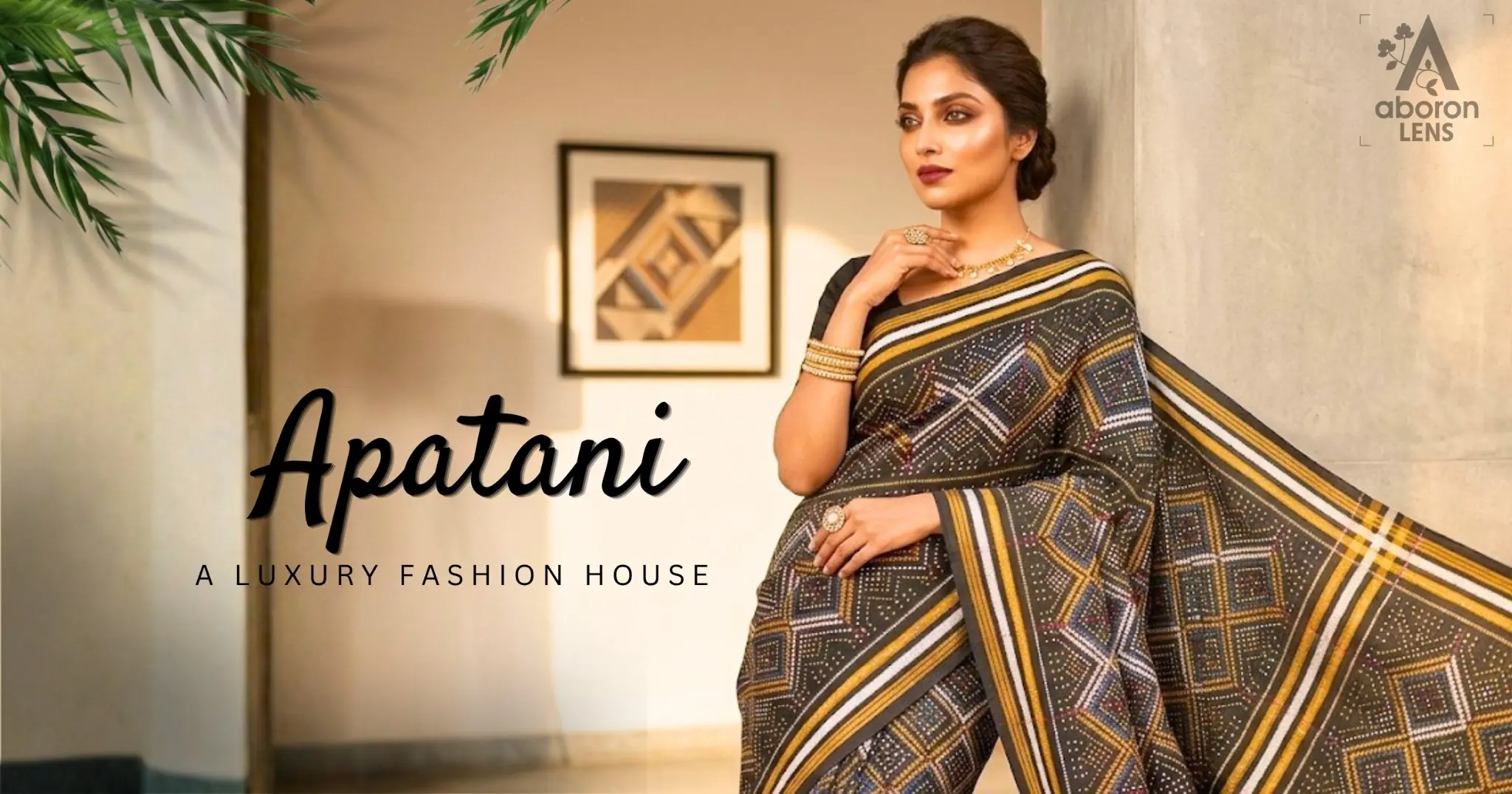
So, picture this, you are standing in the beautiful Valley, where the air is very fresh, clean, and crisp, which gives you a cold sensation in your spine along with goosebumps.
In such a situation, if a rhythmic loom sound comes to your ear from the bamboo house nearby, then be sure that an Apatani Saree is being created on a back-strap loom.
The speciality of the Apatani saree is that it is quite luxurious in the tribal world.
The girl who’s sharp, logical, and knows quite well that a straight line is more sexy than the messy curves, then this fabric is just for them.
Some historical background of tribal fabrics
The territory of Arunachal Pradesh got its present name in 1972. During this time, the place was given the status of a union territory.
In Arunachal Pradesh, there are 26 major tribes, along with 100 subtribes. Each has their own custom, through which their identity is defined.
Their attire is an indispensable part of their heritage.
Adis, Monpas, Sherdupen, Mishmis, Hrusso, Singhpo, Wanchos and Apatani are the main tribals of Arunachal. And the fabrics which the Apatani people use as their regular attire are called the Apatani fabric.
Some specialities of the Apatani fabric
The speciality of the Apatani tribals are they don’t really do anything frilly with their dresses. Their styles revolve solely around geometric precision.
The bold horizontal stripes, zig-zag patterns, all of them feel like the digitalised pattern on the fabric, but the soul of the Apatani remains in its colourful designs.
The contrasting colours are the main scheme of making an Apatani attractive. Deep black with blood red and vibrant oranges, or the simple black and white combinations, are the most attractive and demanded Apatani fabrics of all time.
The diamond-shaped pattern with the angular chevron weaves showcases the horizontal mountain landscape on the fabric. Wearing which feels like wearing the woven map.
Some parts of tribal fabrics
The women from that region generally adorn themselves in a long ‘tunic’ along with shinkha.
The tunic is a long, single-length fabric generally worn at the bottom part of the body, just like a skirt, and Shikha is the fabric folded over the shoulder, stitched only on the sides.
The colour of the Shinkha defines which community the women belong to.
The women of kameng tribe generally wear a plain, coarse shinkha. Whereas the Sherdukpen women wear a cream coloured endi or eri silk shinkha, with green and red piping around the neck and armhole
The Monpa woman prefers to wear a maroon coloured shinkha with white coloured piping.
The Apatan community wears a white shinkha upon the geometrically designed tunic.
How this fabric is created
The Apatani community use a back-strap loom, which is called the lion loom. The weaver literally uses her own body weight to keep the tension of the thread. It seems like creating an art form while doing a heavy workout.
Apatani have been using plants like tamim as a natural dye for the gorgeous red-orange colour of the sankhi ( Upper wear) for centuries.
Pure breathable cotton is used, which, after wearing, feels like being wrapped in a cloud.
This 5.5 metre fabric, which is the pride of the apatani community, now reaches a global audience.
Nowadays, many are using Apatani fabric as six yard saree in modern times.
The Apatani weaver community also recently asked for the GI tag. Let’s see what happens next with this fabric.
FAQs
1. Which type of Apatani sarees are now famous?
Apatani cotton saree, Apatani saree, Apatani silk, Apatani Fabric, Apatani coat, Apatani textile worn by Apatani tribals, especially the Apatani women, are now famous.
2. Which state made the Apatani sarees?
Arunachal Pradesh is known for Apatani sarees.
3. What is the speciality of the Apatani weave?
The speciality of the apatani weave is that it is geometrical in shape, and it is woven in the back-strap loom.
4. What is the apatani saree price?
The apatani saree price starts from 5k and goes up to 50k.
5. Are the Apatani sarees available online?
Yes, they are available online, but for the authentic apatani sarees, you have to go to the famous luxury fashion house or the eminent luxury fashion store to avoid the fraudulent ones.