

Baluchori Saree, the fabric where the colonial history is preserved within its threads
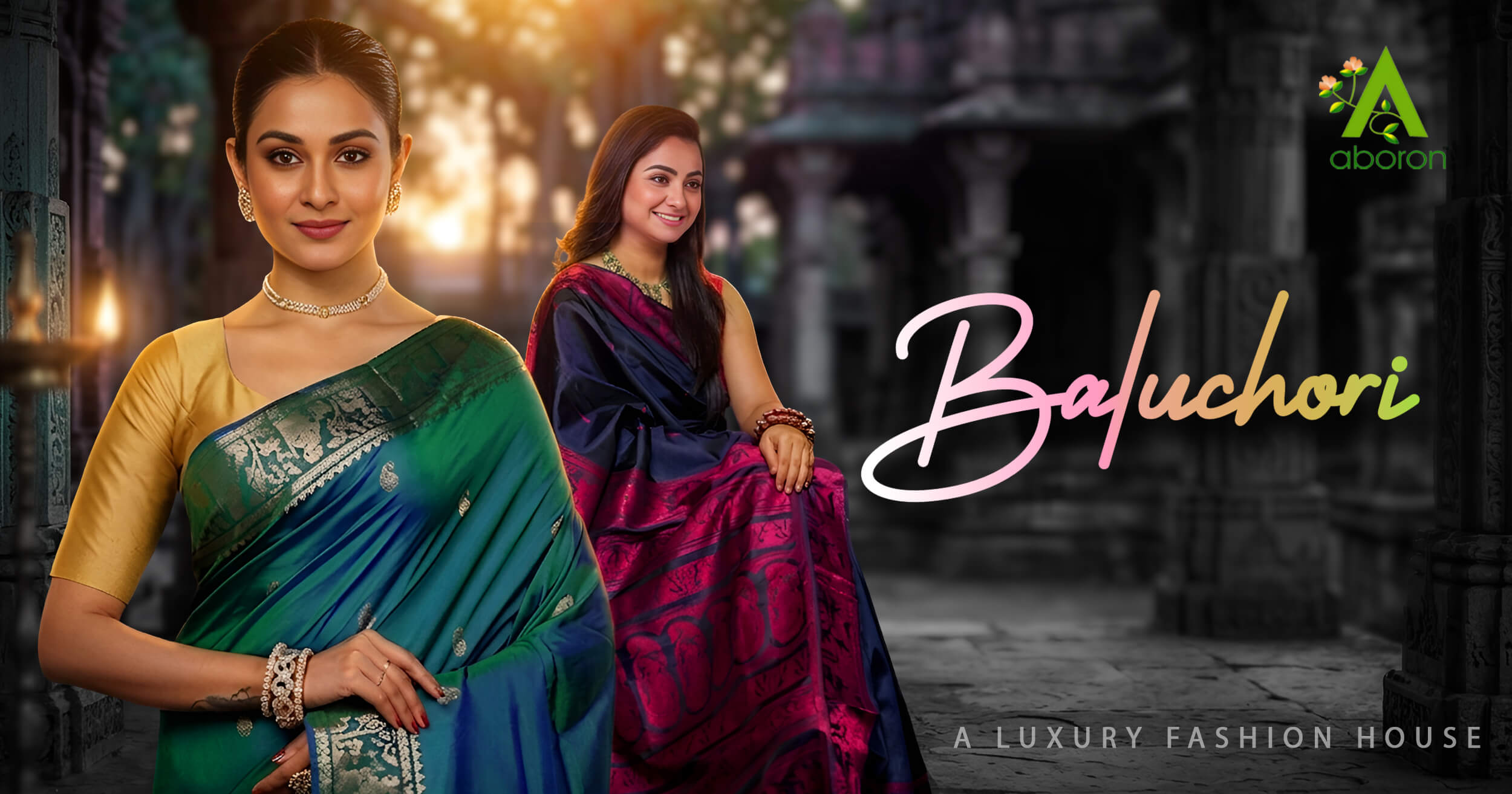
Imagine a saree where a smoking British sahib is woven adorably on the Pallu, with a memsahib, sitting beside him, fanning herself, with an expression of boredom.
Doesn’t it seem like a 19th-century, candid picture, preserved beautifully in the weaving art?
Thats the beauty of Baluchori.
The saree, where the untwisted silk captures the memories of Ramayan, Mahabharat, and Bhagavad Gita, along with the colonial history of the British Raj.
But the purpose of the saree is not to quick-freeze history but to depict our rich heritage with pride and honour.
History of Baluchori Saree.
So, where did the Saree originate from?
You may hear the name “ Murshid Quli Khan’, the Nawab of Bengal, appointed by Aurangzeb around the time 1717 to 1727 BC.
This Hindu Brahmin, later converted to muslim, had an immense interest in weaving art.
So he brought some technicians from Dhaka to his capital, Makshudabad, currently called Murshidabad, to patronise these ancient crafts.
Later on, around five centuries ago, somewhere on the banks of the Bhagirathi River, this special type of weaving practice suddenly began to boom.
The name of the village was ‘Baluchor’, where a community of skilled weavers started crafting their own art on 6 yards of fabric, and started calling them ‘Baluchori Saree’.
However, time is the biggest game changer.
The flood came, and the whole village just drifted away, only within a day.
But how can a natural calamity destroy artists and their art? During that crisis, some of the artisans migrated to Bishnupur and started crafting sarees again. Proving that, the stubborn survival theory of Darwin was so damn real.
Baluchori Sarees Evaluation: from the 20th Century to the modern day
Baluchori’s history didn’t stop here.
During the 20th century, the craft totally died.
A thread artists named Subho Thakur, along with master weaver Akshay Kumar Das, played a pivotal role to revived this heritage.
Before that era, these sarees were called storytelling silk, as the prominent stories from the Ramayana and the Mahabharata were woven upon it. But during the British Raj, the designs changed to colonial humour.
Still, the elegance remains intact across Bengal and beyond.
The Procedure of making Baluchori Saree.
How is the Baluchori Silk made?
The making process is nothing but a synonym of hard work and patience.
Silkworms are carefully cultivated for their cocoons. Once the worms grow up fully, they are boiled and dyed in a bright colour. After dying, the silks are stretched and prepared for weaving.
The motifs and the Border designs are first drawn on paper, and then they are transferred to the loom using punched cards.
One Saree takes about a week or even longer to weave.
Two craftsmen had to work together, guiding the loom like musicians playing a complicated duet.
Over time, technology stepped in. Machines like the Jacquard card punching system helped to reduce the weaving time while preserving the beauty and the elegance of the saree. Yet the soul of the craft remains in the magic of the weaver’s hand.
FAQS
1. What is so special about Baluchori Silk Saree?
The in depth story telling artistry in the Pallu of the saree made it different from other silk sarees.
2. Which place is famous for the original Baluchori saree?
West Bengal is considered the most authentic Baluchori hub in the world. But Baluchori Sarees of Bishnupur are also very famous among saree lovers.
3. What is the price of the original Baluchori saree?
The original Baluchori saree is expensive as it is purely handwoven. Generally, the price of an original one starts from 13,000 and goes up to 50,000 to 70,000 rupees
4. What is the main difference between Baluchori and Benarasi?
The real differences are seen generally in the design of the Pallu. The Benarasi saree mainly focuses on the Zari work and floral motifs, whereas the Baluchori saree focuses on the paintings inspired by Hindu mythology.
5. How are Baluchori Sarees woven?
Baluchori Sarees are generally woven on the Jhala loom, called the Jacquard loom now. After drawing the design on paper, the intricate weaving starts.