

Traditional Blouse Piece to 6-Yards? Know how Khann Saree’s journey evolved
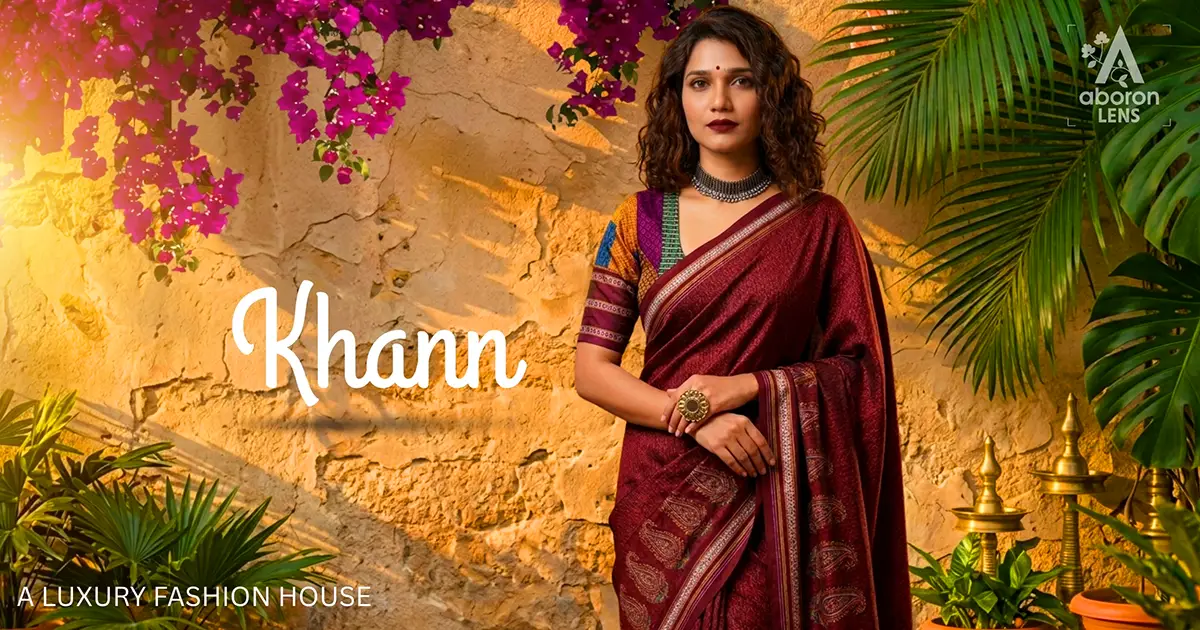
Have you ever seen such fabric that is so antediluvian that it would surely reveal something new if we analysed it under anthropological scrutiny?
But the interesting fact is, you will never feel that primitive vibe when you just look at it. Rather It just glows with the intensity of a thousand sunsets.
This is the beauty of the Khann fabric. A piece of Deccan, seeing which your eyes will start crinkling.
But history depicts that this fabric is basically not for the sarees, which means if a Kannad girl asks for a ‘khann fabric’ to the shopkeeper, then the shopkeeper should quickly understand that she is not asking for a saree, actually she is asking for a blouse piece.
Origin of the Khann Saree
This narrow - lined saree is very humble but very much aristocratic in nature.
‘Khann’ - this word is derived from the Marathi and Kannada word ‘khan’, which literally means piece or part.
This fabric was first born in the districts of Dharwad, Gajendragadh, and Shirol in Karnataka, as well as Sholapur and Ahmednagar in Maharashtra, proving that both the places are associated with the fabric’s origin.
It was the hard labour of the Devanga and Lingayat weaving communities, whose consecutive hard work for designing still kept the art breathing till now.
What’s so special about Khann Saree
But do you know what actually makes the Khan fabric truly special?
It is its visual soul, which not only captivates the buyer's eye but their heart too. The mix of silk and cotton yard now been replaced by rayon or synthetic zari. But the appeal remains the same.
The beauty of the saree lies in its ‘dhup-chaya.’ ( Sun and shade) effect. A shimmery shot-coloured fabric is achieved by weaving different coloured threads in the warp and the weft.
This special woven method gives the fabric a twilight body.
Previously, the body was woven with the naturally dyed marron or other matte colour.
But nowadays, in the era of the glam and gorge, this matteness is now extinct from the saree.
And a special type of the sjimmery look has now been introduced to keep this saree relevant to the gen z’s.
Know how you can identify a Khann Saree
Its border and motifs are also quite different from the other sarees. The narrow lines in the border are quite dense.
Traditiobally this kind of borders are called “parapet pattern”. This pattern basically forms when the pattern is woven with a supplementary weft.
The motifs are also like simple geometry. Just like a normal circle, triangle, or square.
The motifs also sound like the poen of Indian soil, - Tulsi leaf, Motichur, Asavari. Among more than 1000 motifs used to decorate Khann, these are the most used and relevant ones.
FAQs
1. What kind of Khan saree dresses are now very trendy in fashion?
The Khan Saree Blouse and Khan Saree Lehenga are now very much in fashion.
2. Which colour khann saree is now in huge market demand?
Blue colour Khann saree now has a huge market demand.
3. Is Khann saree online Available?
Yes, not only the Khann saree, Khann Saree dress design, Khann Saree Blouse Piece are also now available.
4. What is the origin of the Khann saree?
This saree originated in the 8th century during the Chalukya Dynasty, which ruled Karnataka at that time.
5. How does the ‘Khann saree look’?
You can create many looks through this shimmery garment, but if you pair the saree with some south temple jewellery, then the styling looks absolutely picture perfect.
6. What is the Khann saree price?
If you tally in Google by searching ‘ Khann saree online’, you can compare the price, but generally the price starts from 5k and goes up to 50K depending upon the design, motif and the handwork.