
logo
  • Home
  • Blogs
  • Aboron Story
  • Contact Us
  • Login / Register

  • Notice: Undefined variable: count_cart in /var/www/html/aboron/blog-details.php on line 264

    Notice: Trying to access array offset on value of type null in /var/www/html/aboron/blog-details.php on line 264

    Notice: Trying to access array offset on value of type null in /var/www/html/aboron/blog-details.php on line 264

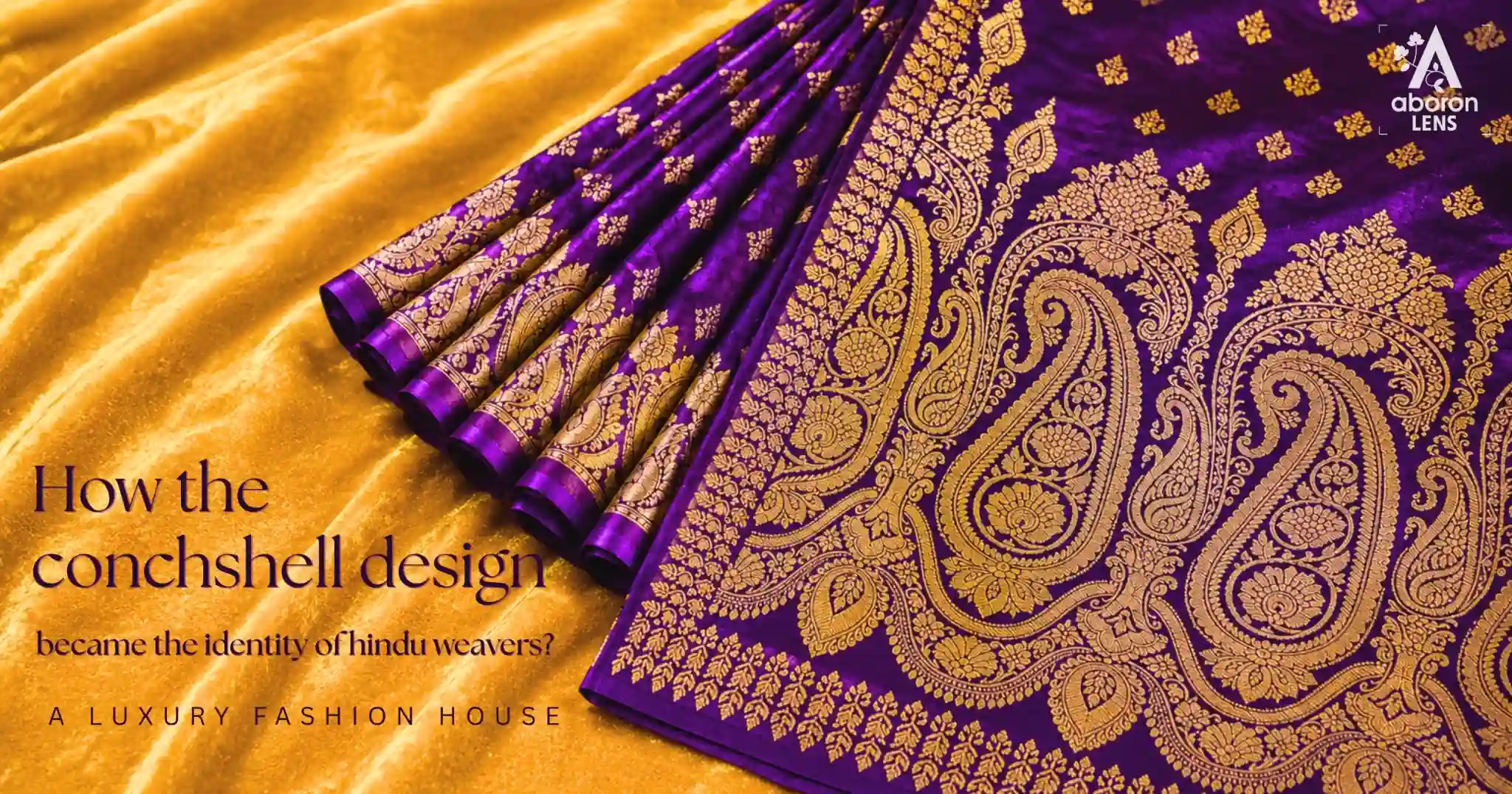
Know how the conchshell design became the identity of the Hindu weavers
  • 22 Jul 2026
  • By Aboron
Know some interesting facts about the Banarasi saree, and know how the conchshell design became the identity of the Hindu weavers
Call

If you want to know more about the banarsi saree, then don’t go with the manuscripts; talk with the local weavers.They would tell you something which the historian could never dig up.

Whatever you know about the Benarasi saree today, that’s all bookish, 

The real knowledge was crushed underneath the dust of Banarasi looms.


You need to dig up more to learn it, understand it, and moreover to value it.


The books written on Banarsi saree can give you the timeline of its evaluation, but they can’t tell you why some weavers make Benarasi with sankha motifs, while others don’t.


Let’s dive into the ocean of Banarasi to know some real facts.


Know why the Hindu weavers started weaving conchshell on the Banarasi Saree


As described in the book, previously, the Benarasi saree was woven only by the Hindu weavers.

Then came the Mughal era, when the Banarasi sarees' identity took a shift as the muslim weavers also started weaving the saree, giving an Islamic touch to the design.

After a prolonged period, the Muslim weavers took over the hegemony in the weaving industry and started torturing the Hindu weavers.

The hindus fleed from their own place and created their own hub far away from the banks of the Benaras.

But born artists never separate themselves from the art. That is why they also started weaving banarasi 

But to distinguish their banarasi from others, they started incorporating the Hindu motifs like Shankha (Sacred Sconch Shell), Tota, and Moyna birds in their banarasi saree so that people can distinguish which ones are made by Hindu weavers.

This is how the Hindu symbols started to incorporate in saree motifs.

Know what the scenario of today is 

Today, the “game” of Banarasi weaving is no longer about total dominance. Now the challenges have shifted to the artisan’s survival because the powerloom steps in.

Now, to retain the authenticity of the pure Banarasi saree, which still holds the centuries-old flame, NGOs and the government have taken some significant steps.

They are given a subsidy so that the artisans of Madanpura or Alaipura, who were considered the real keepers of the Banarasi weaving style, can survive even if their product is not sold for the extremely high price.

These sarees are also woven in the Kadhua technique by the Hindus, where the motifs are woven separately to ensure the human art remains unreplaced.

Nowadays, the delicate zari work is also done by hand, to make Banarasi sari an epitome of human patience and real handcrafted artwork.

Share
Latest Post
Khandua pata silk saree, Khandua pata saree, Khandua pata saree of Odisha, Khandua pata saree worn by Lord Jagannath
  • 17 Jul 2026
Khandua Pata Silk Saree: The Fabric used to adorn Lord Jagannath
Raghunathpur Tussar, Raghunathpur Tussar Silk, Tussar Silk Saree, Silk Saree of Raghunathpur, One of the prominent Tussar manufacturing hubs of  Purulia, Raghunathpur Why Tussar is considered one of the best manufacturing hubs of India
  • 15 Jul 2026
Know how Raghunathpur, Purulia become the manufacturing hub of Tussar Silk
Samudragarh Tant, Unknown Weave Heritage of Bengal
  • 13 Jul 2026
Samudragarh Tant: Know About the Unknown Weave Heritage of Bengal
Blue Denim, history of denim jeans, evolution of denim, how denim became a global sensation
  • 9 Jul 2026
Know how Denim created a blue revolution in the textile industry
  • Address : 76/132, Mini Bus Stand, Madhusudan Banerjee Rd, near Birati, Mahajati Nagar, Birati, North Dumdum, West Bengal 700051

  • E-mail : info@aboron.co.in

  • Phone : +91-8272912673

Recent Posts
Our Stores
  • India
  • UK
Useful Links
  • Contact Us
  • Blogs
  • Aboron Story
Social Links
  • Facebook
  • Instagram
  • Youtube
  • Pinterest
  • Medium

© Aboron Theme. All Rights Reserved.