

Know the fascinating history behind the iconic red-and-white Garad saree
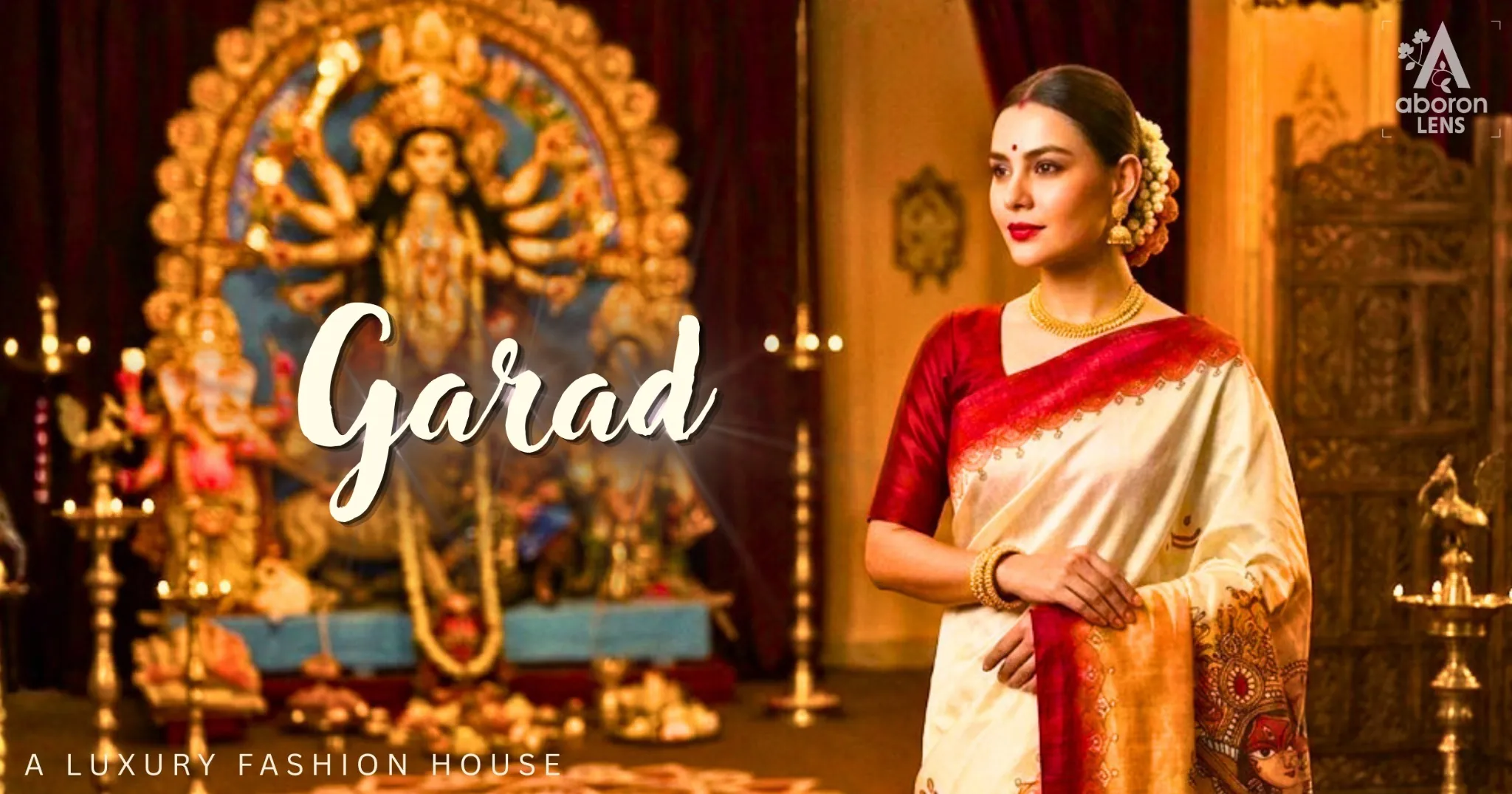
In this era of neon-coord set or Instagram aesthetics, the red-bordered Garad saree can be felt archaic. But let me tell you, Bongs always believed that old is gold.
And being a bong, I also do agree with that.
Garad is not just a piece of cloth for us. It perfectly resembles our art, culture, and ethnicity with grace and pride.
If you have ever watched a Bollywood climax, centred around Kolkata, then you must have watched the scene where ladies are enjoying the ‘sindur khela’ during Durga Puja, wearing an off-white silk saree with a striking red border.
Yes, this saree is nothing but the Garad saree. Very minimalistic yet traditional.
But behind those gorgeous drapes, there lies a fascinating history.
Let’s dive deep. Because we are about to explore something interesting.
The history and evaluation of the Garad saree
The word garad means white. But this white is slightly different from other whites. This saree is made of 100% pure mulberry or tussar silks.
Back in those days, the undyed silks were used to make the sarees because during that era, the sarees were the symbol of purity and sanctity.
Thatwhy these sarees became the designated uniform of holy rituals, especially during worshipping the deities or on occasions like marriage, rice ceremony or sting ceremony.
Garad sarees are basically woven in the region of Birbhum and Murshidabad. When you first touch a brand new garad saree, you will surely get confused. The confusion would be: Is it really silk or parchment paper?
Its distinct crispy texture is the main reason why such confusion arises. But let me tell you, this paper-like texture comes from natural starch, used during the wrap and weft of the traditional garad saree.
But this texture doesn’t stay forever. When you drape, it will soften beautifully and cling around your curves gorgeously.
During the 15th century, which was the time of the Mughals, Bengal was the textile capital of India. But garad sarees of that era were quite different from modern times.
Know what the difference is between the modern Garad Saree and the 50’s Garad Sarees
The modern Garad saree, infact the designs we know today, was created by a weaver named Mrityunjay Sarkar from Mirzapur.
Padmaja Naidu, the former governor of West Bengal, was an iconic Garad lover, who is still remembered for her fondness for garad saree.
During the 50s and 60’s, she made these sarees so famous that they were also called ‘Padmaja sarees' by the commoners.
Even Prime Minister Indira Gandhi used to regularly source her handwoven pieces straight from the weavers of Mirzapur, which also made this saree a political style statement during her era.
But nowadays, many people get confused between the garad saree and the Koriyal saree, due to their similar appearance.
Let me tell you how you can differentiate
Garad features the plain white body, with small butas and a simple stripe pallu. It also contains a simple, narrow red border.
But Koriyal’s red border contains some intricate zari work, which gives it a more bridal appearance.
Apart from that, Korial originates from Kora saree, which means a blank fabric. But when it is woven for a bridal purpose, then it looks like a pure Benarasi.
In the year 2024, the Garad saree officially received its Geographical Indication (GI) tag, cementing its status as an irreplaceable heritage asset of West Bengal.
The Korial (from Kora, meaning blank) is the Garad’s extra, high-glam older sibling. The silk base is much plusher, and the red border is packed with intricate, heavy zari work. When it goes full bridal, it crosses over into Korial-Banarasi territory.