

Decoding the Art of Dhaniakhali Sarees
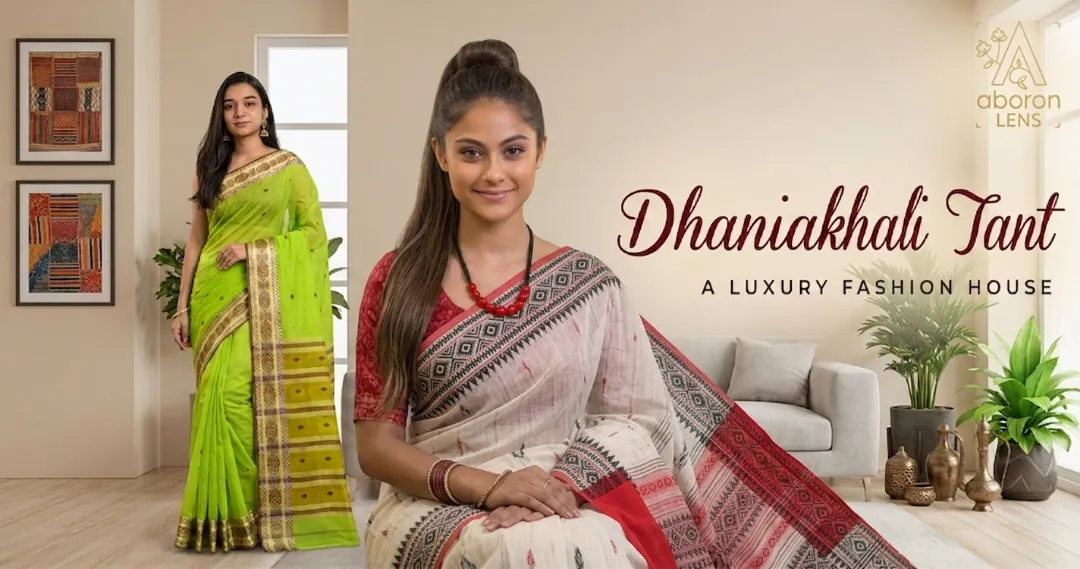
Imagine you are sitting on the verandah of your hilltop cottage, watching silently how the sun bakes the hills.
Isn’t it the perfect summer afternoon that anyone can think of?
Trust me, the ideal summer companion is not about fancy drinks or the AC machines.
It’s just about a piece of cloth, which can protect you from the blazing sun.
If you and I are on the same page, then let me talk about something today which actually feels like a cool shadow on a bright day.
Any guesses? What am I talking about?
Yes, you got it right, Dhaniakhali Saree.
If you are a person who appreciates the simplest things in life, then this one is absolutely for you.
How the Dhaniakhali saree is crafted
The speciality of the Dhaniakhali saree is that it doesn’t shout for attention.
Just like the other flamboyant silks like Kanjivaram, Paithani, Chaneri, this ‘subtle one’ also depicts elegance, but in a gentler form.
Its earthy texture is capable of conquering any aesthetic soul within seconds. Which clearly proves in the world of gorge and glam, subtlety hits different, and Dhaniakhali is the ultimate example of that.
The weavers of Dhaniakhali believed that the ancient weaving format is the only way through which Dhaniakhali’s authenticity will be preserved. That's why they soak yarns of cotton in fresh water for days.
Then they are boiled in a starch, which is made of rice and sago. This method gives the saree its thick, crispy, earthy texture.
And, before it becomes market-ready, the final finishing touch is done by sprinkling water on it and rubbing it with starch again.
Specialities about Dhaniakhali saree
In the old days, all these were done by hand, but now the weavers use a clever contraption called ‘dobby’. This dobby machine essentially utilises several wooden crossbars with a few metal pegs, which help to dictate the loom exactly which threads to lift and when.
Altogether, the process sounds like a jam session, but instead of producing songs, it produces beautiful motifs.
Mangoes, merigolds, and the dancing of the little fishes are the signature motifs the Dhaniakhali saree possesses.
But if you want to identify the real Dhanikhali saree, then you must look for Khajurichoti. This design looks like a braided plait and is woven with patience to adorn the pallu of the saree.
The weavers twist two different colored yarns together to create a single stripe upon the saree.
The border designs are significant, too. Sinthesindhur, a bold red with black stripes, and the Beluari, a delicate quarter-inch border is the distinctive flair of Dhaniakhali Saree.
FAQs
1. How to identify dhaniakhali saree?
If the saree contains a khejur chori design and is woven with a specially twisted two-coloured pallu. Then the saree can be easily identified as a dhaniakhali saree.
2. What is the origin of the Dhaniakhali saree?
Dhaniakhali village of the Hooghly, West Bengal, is the origin of dhaniakhali saree.
3. What is Dhaniakhali famous for?
Dhaniakhali is famous for its handwoven cotton sarees.
4. Where is the famous Dhanikhali saree wholesale market situated?
The authentic Dhaniakhali saree manufacturers are in the Dhaniakhali village, but Dhaniakhali saree wholesale is done from different places in West Bengal.
5. Does the Dhaniakhali saree got GI tag?
Yes, Dhaniakhali saree weavers have contributed a lot to making authentic Dhaniakhali sarees for several decades
6. How much is the Dhaniakhali saree price?
Dhaniakhali sarees’ range starts from 4000 rupees and goes up to 10000 as per the handloom work done upon the saree. You can also see the Dhanekhali saree wholesale price list if you search on Google with ‘Dhaniakhali saree online.’
7. From where can you get the most authentic Dhaniakhali saree?
Dhaniakhali saree Flipkart is the most authentic place where you can get your preferred Dhaniakhali saree.
8. What is the Dhaniakhali saree speciality?
Khajurichoti is the speciality of dhaniakhali saree.