

Mata-ni-Pachedi: Everything You Need to Know About the ‘Kalamkari of Gujarat’
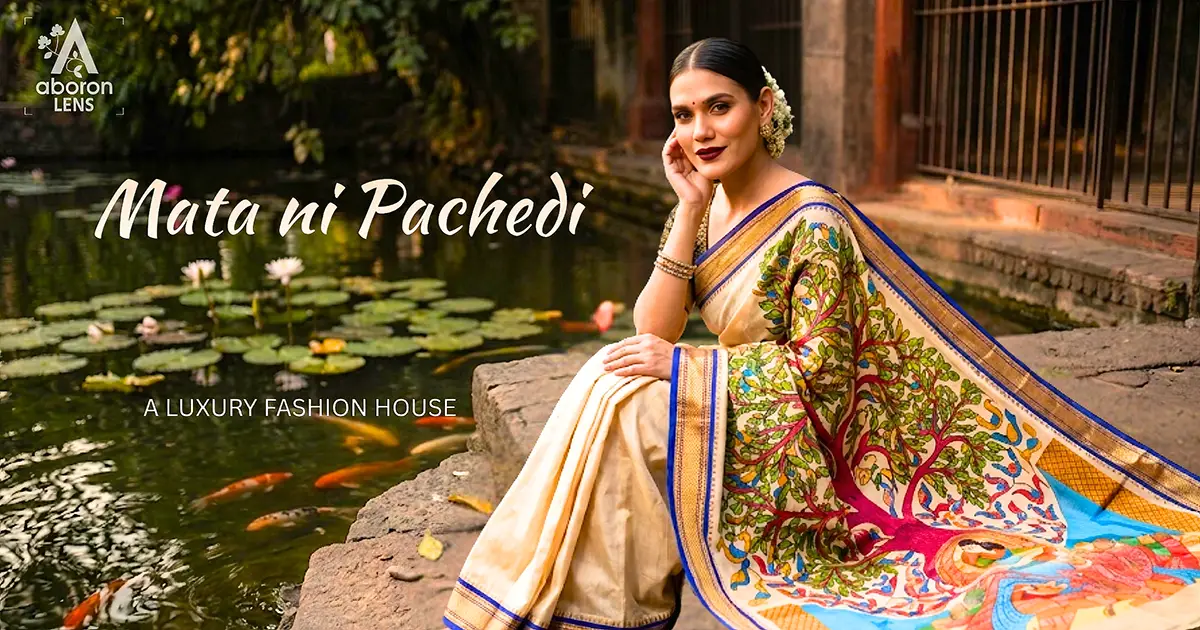
Imagine you are standing in the most inner part of Ahmedabad, and suddenly your eyes are fixed on something, seeing which automatically makes your eyes glaze.
If you also experience something like that in your real life, then you must have seen the old -age heritage art ‘Mata-di-Pichadi.’
The speciality of this fabric is that when you look at it, you just feel like the whole cinematic universe is painted upon it.
The colourful, mystical, mythological vibe of this fabric just feels divine.
Back in those days, the Vargis community, also called the nomadic community, was not allowed to enter the temple.
The sophisticated shrines are only accessible to the upper-class people. But divinity can’t be despoiled from the lower caste. That's why they created special shrine clothes for themselves.
In this cloth, they used to create the paintings of the gods and goddesses. And that is how they used to worship their deity.
The story clearly depicts that the divine himself came to them through the ‘Mata-di-Pichadi’.
That's why this cloth is associated with the faith, belief and devotion of the Gujarati commoners.
History and evaluation of Mata-ni-Pachedi painting
The name ‘Mata-di-Pichadi’ literally means "behind the goddess." These fabrics are not used as pretty wall hangings. They are something more than that. These paintings are used as sacred scrolls, which were used in ancient times for visual storytelling.
And when this gypsy community roams from one place to another, this movable shrine ‘Mata-di-Pichadi’ fabric also moves with them, depicting its existence as the spiritual dye of Ahmedabad, Gujarat.
There is also “Chandarvo’ a massive square piece of fabric with a circular design in the centre.
It's basically the depiction of the mother goddess and her leela, which is painted on the sides of the circle, throughout the whole body of the fabric.
This goddess was named by rajasthani and gujarati community as 'Goddess Visota'.
There was a famous lore associated with her. The lore says that one day, Lord Shiva and Goddess Parvati were chilling beside the Shabarmati River. Suddenly, they found a dead buffalo. Parvati, being the soft-hearted one, begs Shiva to bring it back to life.
At first, Shiva refused to do so, as he knew that as soon as the buffalo got its life, it would start destroying everything. But later on, he agreed to keep Parvati's words.
After a couple of days, suddenly, everyone started complaining about that Asura buffalo. To calm him down, Shiva made the Vaghri community, a caste still found in Gujarat and Rajasthan.
To kill that Asura, he ordered the Vaghris to worship the twenty-armed “Goddess Visota.”
This Goddess is the main character of the Mata-ni Pichedi painting. As this goddess’s story is painted upon this fabric.
Colour speciality and special motifs done on Mata-ni-Pachedi painting
If you’re a fan of minimalist palettes and the OG colours, both. Then Mata-di-Pichadi is definitely for you.
The pure red used to paint this fabric gives a healing vibe. Black was used to keep the evil spirit away. And pure white colour is used to depict the spiritual energy.
In ancient times, this painting was strictly a male- dominated craft, but now, time has changed, and women are also coming forward to help with the painting.
The designs have also evolved from being sacred and taboo to being showcased in different handicraft exhibitions and traditional art stores.
Goddess ‘Meladi’ on her goat, ‘Hadokai’ (who apparently safeguards from dog bites), and Goddess Jogani, who cures head wounds, are used as the motif of the Mata-ni-Pichadi fabric.
Overall, this beautiful fabric of the chaotic mix of faith, survival, and artistic grit.