
The Dotted saree of Kutch: Why Tangaliya Sarees Are the Ultimate Wardrobe Flex
So, I was flipping through some books on Indian textiles because sometimes you really need a break to get a digital detox. and appreciate something indigenous that has survived for 700 years without any algorithm or SEO.
Trust me, the moment I found out about Tangaliya, I was just blown out.
We never really decoded the real OG of the weaving world. So let’s delve into that to know some real, authentic stuff.
The history of the Tangaliya saree started from the Bharwad community. This community, also known as Dangsiyas, is considered the legendary shepherd of the Saurashtra region.
Mainly, their extraordinary skill to rear sheep and goats is what makes them so unique as a community.
A folk story about the origin of the Tangaliya depicts one day, a young boy from the Bharwad community playfully started weaving the wool of a disposed sheep.
But being a Sudra, he was not allowed to do so. Thatswhy one weaver adopted him and started to utilize the wool he stored in his house. And that is how the first tangaliya was woven 700 years ago.
Speciality about Tangaliya Saree
The word "Tangaliya" comes from tang (legs) and liye (for). It was originally a cozy, woollen, unstitched skirt created to keep the legs warm. But later on, this became a form of weaving, through which sarees are also woven.
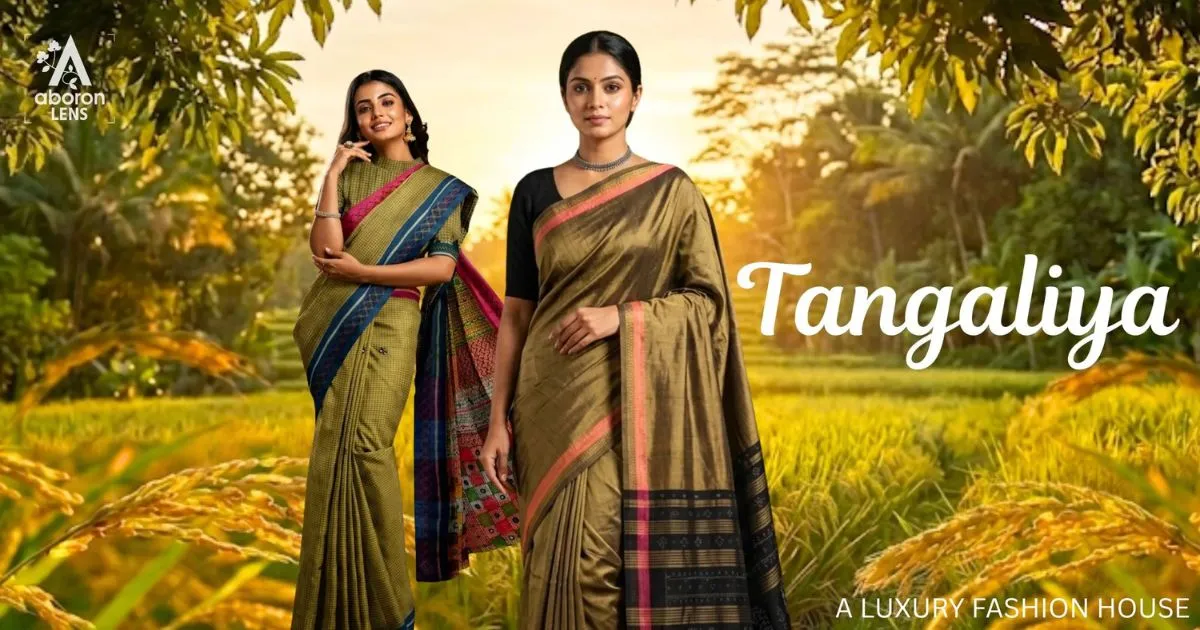
The soul of Tangaliya is its dots, which are also called the Dana.
These dots are not stitched on the fabric later. They are knotted into the wrap while the fabric is being woven.
The weaver literally twists a contrast thread around the warp yarns with their fingers to create such bead-like effects, called “Danakam’
Traditionally, Tangaliya was woven only in black, maroon, and white base. But like any other good classic, it’s evolved. Today, the colors of the saree actually vibe with the seasons.
Orange gave the saree a pure autumn vibe, while purple gave it a winter energy. Red saree gives the saree a hot summer feel, and the green saree gives it a refreshing spring aesthetic.
How a Tangaliya saree is woven
The Peacock, Mango, and Sasala-nu ghar, the rabbit house, is considered the most signature motif of the saree.
But as the world changed, so did the ‘Tangaliya’ weavers. Some ‘Vilayati’ foreign motifs are also introduced. Buses, airplanes, and balloons have become the popular motifs of ‘Tangaliya later on. As if a 700-year-old craft were deciding to go for urban chic.
The Tangaliya weaving process is not different enough from the other weaving methods. The Spinning, dyeing, and starching are done as a regular weaving procedure.
The speciality about weavibng Tangaliya saree is that the looms are only about 3 feet wide. thatswhy the full wrap is woven in two separate halves.
When both halves were ready, they were joined by a simple running stitch. No fancy "finishing" chemicals or anything, just a good old dusting is enough to get the loom particles off and make the saree piece ‘market ready’