
Discover how a minimalist Khadi saree is born and evaluate
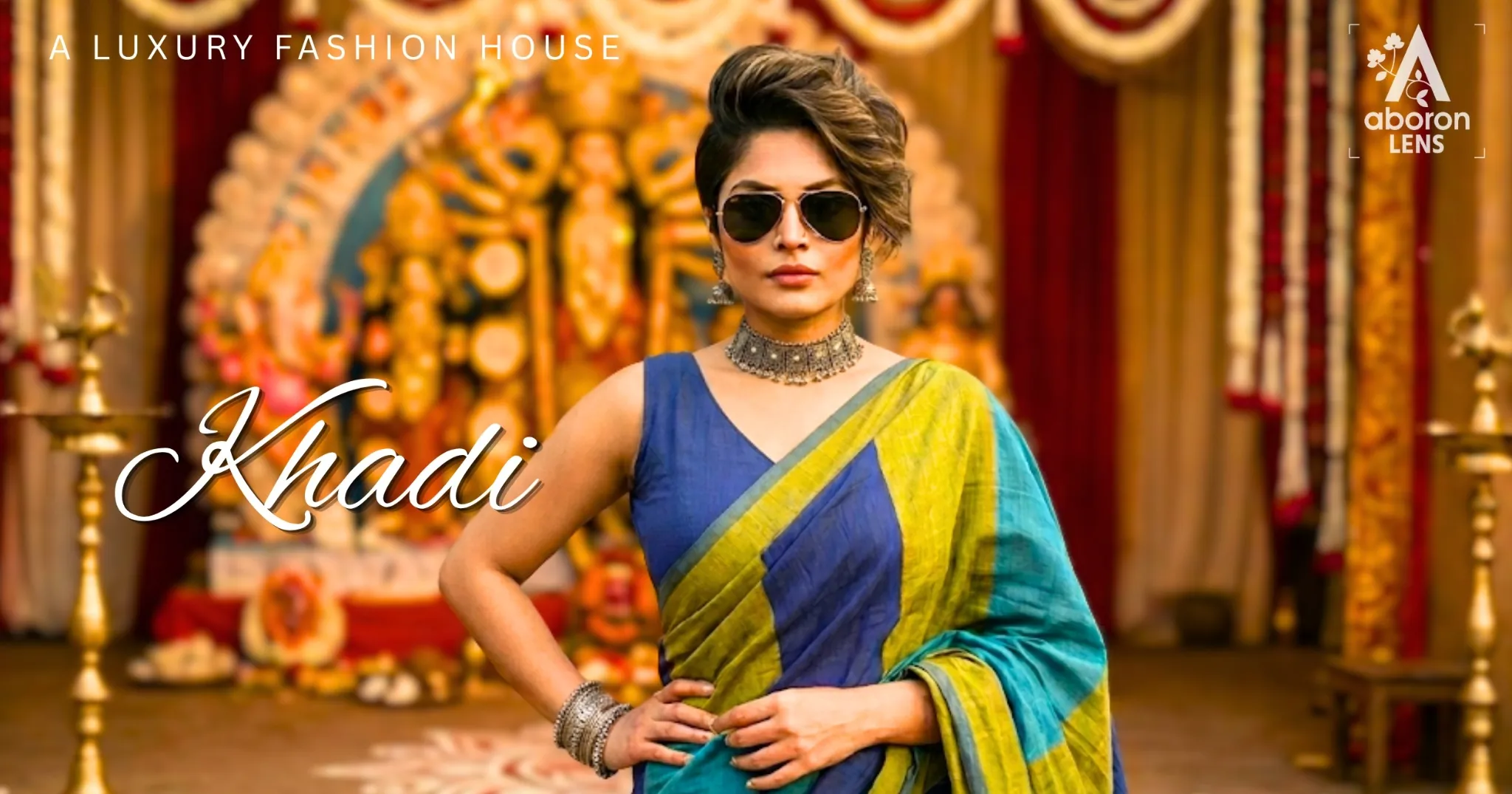
Many saree enthusiasts have now realised that love is much like a perfectly draped saree; you need to constantly give attention to it.
If a saree lover doesn’t complain about her sarees, then you could easily figure out that the love is not real.
And if the love for saree collided with the love for history, then khadi must be your kind of fabric.
Its rustic, dramatic, textured appeal can melt any ‘stoned heart’ within seconds.
But in the world of smooth finishes, why is this rustic and textured fabric still considered attractive?
Let’s be honest, most people think khadi is still relevant because of its text-heavy history, political references and being a symbolic epitome of independence.
But back in the 1900s, India was literally flooded with cheap, machine made british textiles. Britishers basically made India their market, but the quality of the fabric was compromised.
Mahatma Gandhi looked at that and pulled off the most discussed move in history, ‘ Swadeshi Andolon’
He advised the entire nation to boycott foreign cloth and sit with our own indigenous thread-cutting machine, ‘Charkha’ and make the nation's own fabric.
It wasn’t only about producing your own clothing its about creating a revolution through which the agitation against the Britishers solidified.
That is how our own indigenous khadi was born in India.
History claimed that the first official hand-woven piece of khadi was born around 1917 at the Sabarmati Ashram, Gujarat
Because of its coarse, texturous surface, Gandhi named it Khadi.
The word actually came from the word ‘khad’, which means pit.
You must be wondering why a fabric is named after the pit?
The reason is that the traditional weavers literally sat on the ground with their feet inside a pit to weave this fabric, and from that pit, the looms were operated.
Why the Khadi Saree is the Ultimate Modern Flex
Instead of its subtle ‘look and feel’, this fabric goes well with the formal functions as well as high-end art galleries.
In this thriving fast-fashion era, this saree’s minimalistic approach still owes us for its unique appeal from the mainstream sarees.
You must be wondering how it is woven. What is so special about weaving a khadi saree?
Here is your answer.
In the rugged, organic hand spun this sarees are woven. Sometimes the khai is also woven in luxurious silks. But mostly our authentic indie cottons are used to weave this saree.
Whenever a girl wants to look fancy, classy, and wants to depict her intellectual depth, then that's what she wears.
This linen used in khadi is completely biodegradable, structured, and crispy in nature.
Some Mind-Blowing Facts about Khadi Saree
In the period of mix and match, this OG fabric is the ultimate breathable fabric. It's literally working as an air conditioner. Because the process of weaving khadi literally makes a lot of microscopic air pockets, which makes it breathable in the scorching summer.\
Most fabrics start dying the moment you wash them. They fade, they pill, they lose their shape. Not Khadi. Authentic Khadi settles, softens, and actually gets more comfortable and beautiful with every single wash
And khadi also relies entirely on human energy (spinning and weaving) rather than massive, electricity-guzzling industrial factories
The real Khadi saree is just like a fingerprint. It cannot be perfectly replicated by the industrial machines.