

Where are the Handcrafted Sujani Embroidery Sarees from? Gujarat or Bihar?
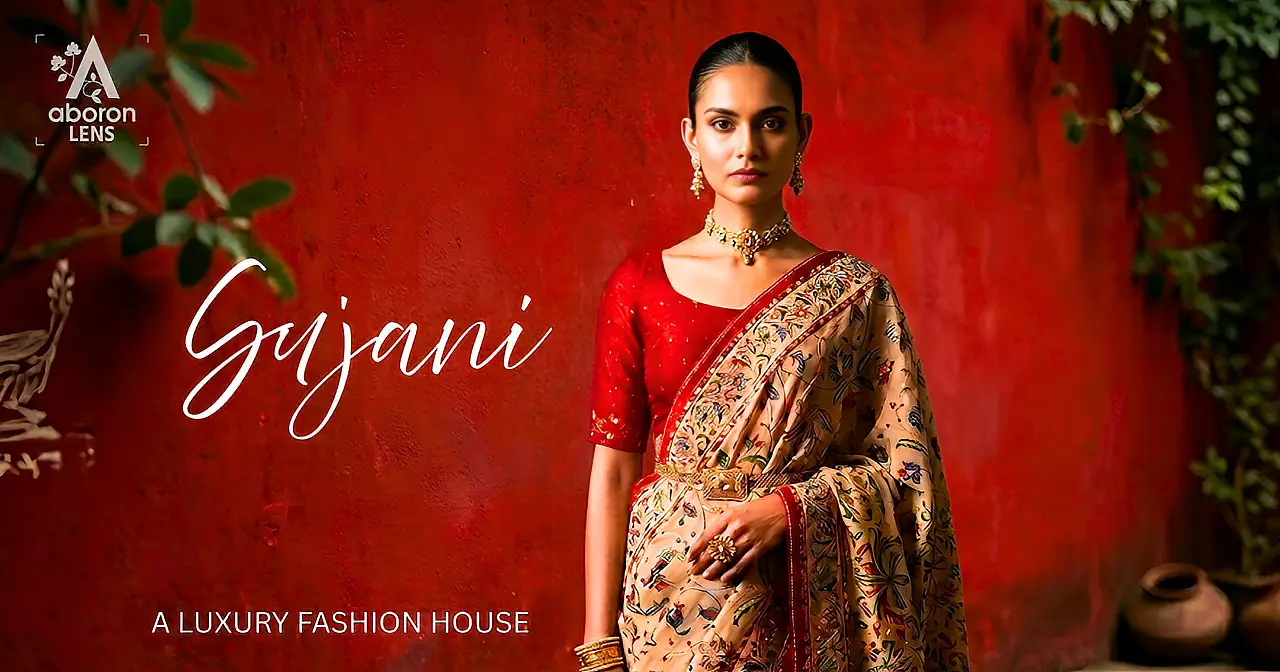
Have you ever heard about Bharuch? A city that has been around for 8,000 years. Experiencing such a historical place must be a staggering moment for you. But when you discover that the city was the port of ‘Barygaza’ to the Greeks, you would be more astonished.
If this intro has invoked a wave of excitement within you, then welcome to the world of ‘Sujani ’, the cloth of Gujarat, which still preserves our colonial era within its threads.
Staring at this fabric feels like looking at a three-dimensional mathematical marvel. tiny square pockets are created throughout the whole body, then the weavers stuff the pockets with cotton wool. No stitching, no needles, just the pure architectural weaving. Make the whole fabric look like a cheeseboard.
This padded design is the foundation of this fabric.
The history of Sujani embroidery
The birth story of Sujani is also quite interesting. A textile manuscript claimed that this craft is attributed to the master weaver named Nabubhai Sujaniwala.
He is considered one of the legends of textile fabrication. He once invented the technique of making ‘Charsa Cloth’ for the Arab traders. One night, he was sleeping deeply, and in his dream, he saw a new method of weaving and sewing.
He woke up and translated his dream into the very first Sujani quilt.
That is how dear Raeder, the Sujani embroidery, makes its way to the world.
Speciality of Sujani Embroidery Fabric
The Sujani meaning has a linguistic war. Some say the word is derived from the term sajuun, which means to convince.
Others say that the word comes from the Persian word sujan, which means needlework. But today, this Sujani fabric is famous for not using a needle in the fabric.
All the design and processing are done on the loom.
Though the needlework is not a part of the sujani-making process, producing a sujani is nothing but hardcore engineering.
The loom is widened to 72 inches long to weave Sujani embroidery. To handle this massive eight-harness loom, more than three weavers are needed. All of them operate six treadles together to create a perfect shed where the weft is passed.
As the pockets form, they are manually filled with the cotton wool, using a five-inch copper rod, called Sua. Though with time, the cotton wool is now replaced by acrylic wool, but the look and feel remain the same.
While creating it, different teadles do different work. One wrap and the other locks the pocket- stuffing.
Today, despite having more than one and a half centuries of history, this craft still needs life support. Only four to five families from the muslim community of Gujarat are now involved in producing such Sujani art.
So dear reader, instead of buying the factory- produced quilt, buy this old- age heritage, Sujani kantha, and join the force who are trying vigorously to revive this dying fine art.
FAQ
1. What is the Sujani motif?
The motifs used to decorate the Sujani embroidery saree are called the sujani motif.
2. Does Sujani Enbroidery is famous in Bihar?
Though the craft originated in Gujarat, now many other states are also carrying the legacy by making a hub in a part of their area. Bihar is one of them. That's why Sujani Enbroidery Bihar is now also famous.
3. Sujani fabric price?
The price of Sujani fabric starts from 5K and goes up to lakhs, but due to the lack of manpower and proper sponsorship, the art is now becoming distinct day by day.
4. Is Sujani embroidery saree online available?
Yes, they do. If you search on Google, you will get to see a lot of online sujani hubs that can also act as your personal saree supplier