
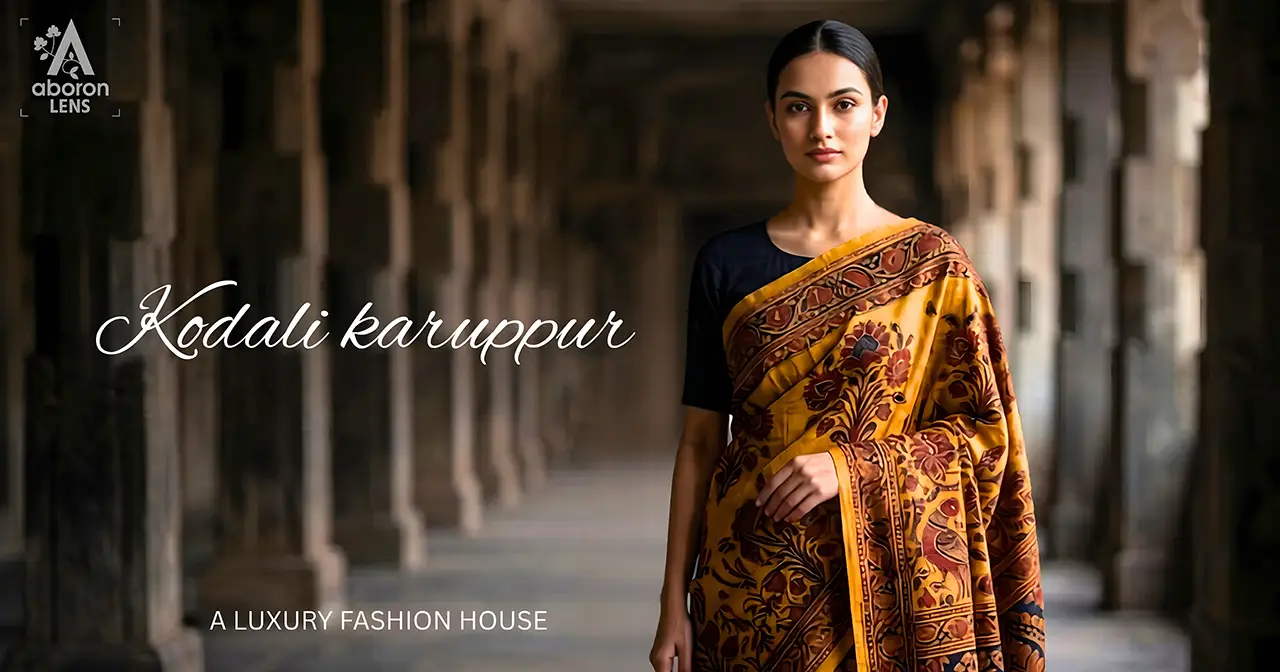
The Royal Legacy of Kodali Karuppur, where the Kalamkari designs are done on silk
Are you also seekers of the finery and ancient lore, or do you also have an immense interest in primitive fabrics?
Don’t worry, seeking something doesn’t always need an early voyage or expedition.
You can also just sit comfortably in your bedroom, surf through the Google blogs on your laptop or phone. Doing so can also give you something that feeds your soul to the brim.
Today, let me tell you about something regarding such a prehistoric object, reading about which can also give you goosebumps and make you feel nostalgic.
So the ancient fabric is called ‘Kodali Karuippur.’ A garment not merely woven of thread, but it breathes the history of the royals.
The History of Kodali Karuippur fabric
In the sun-drenched lands of Tamil Nadu, specifically within the noble court of Tanjore, this textile was born during the seventeenth and eighteenth centuries.
The fabric is made of ‘Twas’, a special kind of cloth, born to the rarest union of Northern Jamdani with southern hand-painted mordant.
Between the year of 1780 and 1830, during the reigns of Tulalaji and Sarfoji, these sarees were considered ‘Khillat’, the dress of honour.
No Maratha bride of Baroda or Satara would dare approach the altar without this treasure on their wedding. Even the groom also made their turban using this Karuppur fabric.
The Making process of Kodali Karuippur saree
Do you still think this is a simple cloth?
If your answer is still yes, then give yourself a break. It's not.
It is a feat of alchemy. First, the weaver creates a fine cotton muslin, braided with zari to create the canvas. Then it is drenched in buffalo milk and myrobalan liquid.
If you don’t know what Myrobalan is, then let me tell you, Myrobalan is a dry asian fruit, used in Ayurvedic medicine.
Then the artists come with a pen, tracing the pattern with wax. After the design is done, the cloth is plunged into the madder bath, so that the alum-touched areas pop up with vibrant colours, and the rest remain dull.
Unleash is created for modern Gen z’s the traditional Kodali Karuippur saree is restricted to only three colours. The deep red, the dark indigo, and the creamy yellow. The pallu holds the main energy of the saree. Here, the golden zari is just shining through the painted dyes.
As the 19th Century is taking its final breath, Thatswhy many weavers are now shifting their professions. That's why the industry is now beginning to dim. In the year 1915, Sir William Snelling Hadaway surveyed the land, and he discovered that due to the lack of patronage, the craft had already been languishing.
FAQs
1. Is Kodali Karuippur silk saree available online?
If you search Google with the term ‘Kodali Karuippur saree online’, ‘ Kodali Karuippur buy online’, ‘Kodali Karuippur saree online shopping with price’, you will get a lot of options where you can buy the saree directly from.
2. What is the Kodali Karuippur saree price?
The price of the Kodali Karuippur saree starts from 5k and goes up to 15k and above.
3. What is the Kodali Karuippur saree state?
Generally, it is from Tamil Nadu, so you can get the authentic saree only in Tanjore, Tamil Nadu.
4. Where can you get the Kodali Karuippur saree original?
Now Many places are the hub of the Kodali Karuippur. But the authentic one you will get online in Tamil Nadu.