

Indian Drapes: Unfolding Saree Draping Styles from Coast to Coast
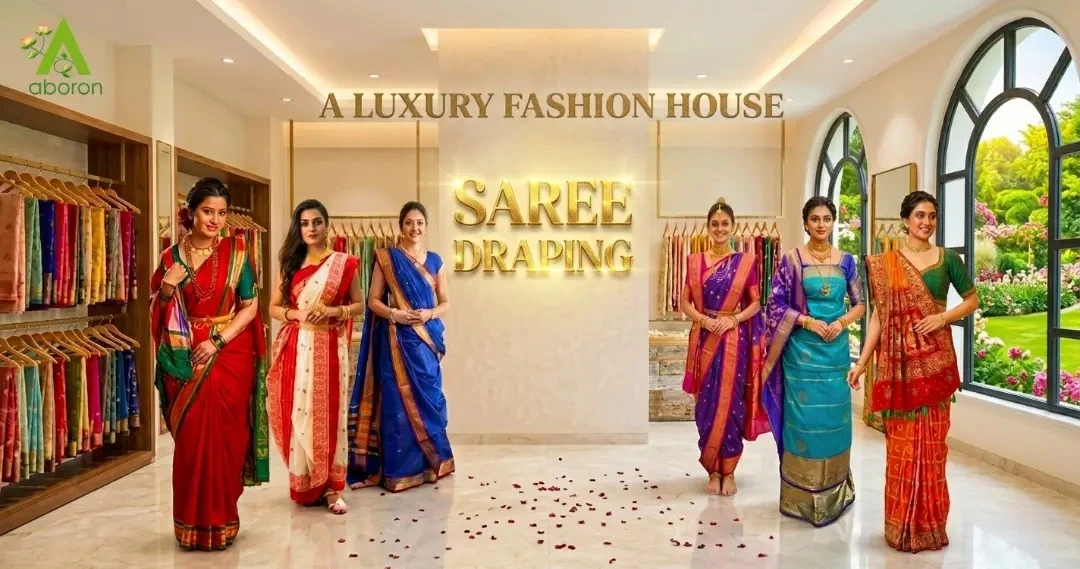
Imagine the rain drumming in a steady rhythmic beat on the tin roof of your cottage. In such beautiful weather, when the world’s pace slows down like sloths, the only feeling that fills our heart and soul is the ‘Nostalgia’.
Bongs have the bad habit of being Nostalgic almost for everything.
Starting from Tagore to Alu posto, Mahanayak to Boimela, even the Durga puja and its sarees, they put their sentiments into almost all the things they like.
For instance, the Saree. Especially the ‘Lal pere’ one.
These red-bordered white sarees no doubt depict the most authentic Bangaliana.
But let me tell you, the way we proudly rant about our ‘saree’s authenticity’, it’s entirely not like that. It also undergoes certain colonial changes.
So the authenticity is a myth that can be proved by studying the history of saree drapings.
So let’s delve deep to understand that, and stay with me till the end, because it’s gonna be interesting.
The history of saree draping
Centuries ago, the saree was wrapped directly against the skin. No restrictive petticoat, not even tight blouses. It’s just the saree loosely hanging on the woman’s curves.
Then came the Victorian era.
To the snobby Britishers, this traditional draping style was considered ‘uncivilized’. thatswhy they started to teach the ladies to cover their bare midriff with fine muslins.
This is how, dear reader, the modern draping was born.
Jnanadanandini Devi, Tagore’s sister-in-law, also played a pivotal role in popularizing this modern drape, which we call today the Nivi style drape.
So what’s her story? How did she become the ‘main lead’ of such a feminist episode?
Well, once a Britisher refused to let her into their club for her ‘blouseless’ saree look
She couldn’t bear the insult. Later on, she adopted the blouse and petticoat as a part of her styling. She also advocated doing the same to other girls of her generation.
Most of the modern draping style is derived from this.
Nauvari style saree draping
In the Maharasthra, nauvari draping is generally observed as the most common draping style among mulgis (Maratha beauties).
The 9-yard fabric is basically put on between the legs, which seems like trousers.
But girls wearing trousers? That also during the 16th century, how is it possible?
Dear reader, the beauty of the Sanatani culture. They are far more advanced than modernism.
During the time of Chatrapati Shivaji Maharaja, woman ride horses, led chivalry, along with cooking for their infants in the kitchen.
And Nauvari is nothing but the resemblance of that power.
Athpourie style saree draping
Have you ever visited any Bengali household?
If yes, then you must have seen the bunch of keys tied to the edge of the home’s lead woman’s saree.
That's the power of Atpourie draping.
Once one drapes it, she possesses all the domestic power of the household.
In such draping, the pallu of the saree is thrown over both shoulders very informally. No pleats, no pins, just the saree hanging loosely around the woman’s curve.
Bengali ma- kakima’s loves to drape their saree like this as it comforts them while the scorching tropical heat reaches its peak.
Seedha Pallu style saree draping
In Gujarat, the beauties from the Western Ghats generally drape their saree in such ‘seedha pallu’ style.
In such a draping technique, the decorative pallu of the saree comes from back to front over the right shoulder, just like Jayabhen drapes her saree in ‘ Tarak Mehta Ka ulta Chasma.’ Then the whole energy is invested to showcase the artwork of the Pallu.
This typical Gujju style draping helps our Western beauties to display their expensive weave work done on the edge of the saree.
Kappulu style saree draping
In Andhra Pradesh, a special counter-clockwise draping is famous among Telugu Ammayees. (Telugu young girls). This special drape is done from left to right to create a more layered look.
In such style, the pallu is draped twice around the body, and then the draping ends with a gochi knot at the waist for securing the saree from falling around.
Kodagu style saree draping
In Coorg, Karnataka, the sarees are draped in modern style, but the pallu is tucked in the upper back tightly, then brought over the right shoulder from the back.
This unique style of draping was previously not so famous. After the ‘reception-look’ of famous Telugu actress Rashmika Mandana, this draping style came to the limelight.
Recently, in her post-marriage party in Coorg, her hometown. Rashmika wore a saree in Kodagu style.
Once the image went viral on social media, everybody now knew about this.
FAQs
1. What kind of saree draping style near me is famous?
The Saree draping style Bengali, is famous these days. But now, many saree draping classes are available online, which teach the saree draping at weddings and the saree draping at home in a professional format.
2. What does saree draping meaning in Bangla?
Saree draping meaning in Bangla, means the proper technique of tucking the pallu and pleats so that the wearer can move comfortably without worrying about the falling of the saree