
Himroo art of Aurangabad: The Woven Poetry still alive from the 14th-century
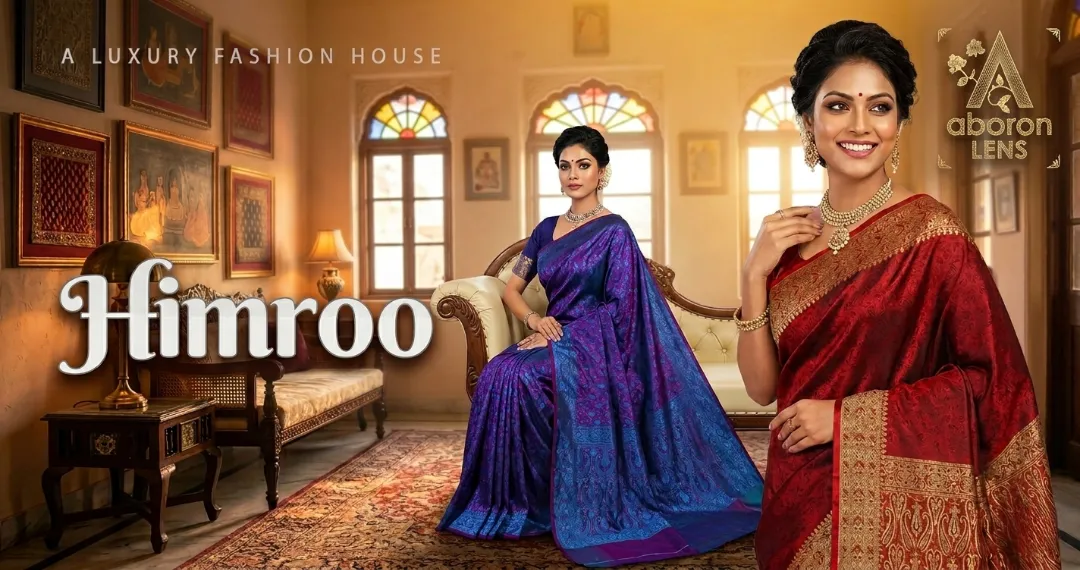
Have you ever seen honey- coloured shadow?
If you walk around the muddy lanes of Aurangabad, along with the rhythmic clack-clack sound, there is a high chance of seeing such a honey-coloured shadow in the alleys through a fabric.
This shimmering tapestry of silk, hung in each corner of the city, is called nothing but the ‘Himroo’. Keenly observing which, you feel like the golden light of the dawn is carefully caught within the threads.
So What is Himroo all about?
The word came from a Persian word ‘ham-roo’, which means Prototype.
Prototype? How come it can be the name of a fabric?
To know why, you need to plunge into its background story.
Are you ready, readers, to delve deep?
Come on, let’s dive.
History of Himroo: The Persian Roots to Indian Soil
Mahammad Bin Tughlaq, a renowned sultan of Delhi, is considered to have made the utmost contribution in shaping Indian fashion.
Without his patronage, many old-age weaving arts would have been extinct years ago.
But he is the one why these ancient arts are still alive. Fortunately, to save Himroo, his contribution is also immense.
Historical manuscripts claimed that during the 14th century, when he moved his capital to Deogiri, along with his personal belongings, he also brought some skilled weavers with him from Varanasi to Ahmedabad.
Later on, when the capital eventually shifted back to Delhi, many of these artisans refused to go back with him. As they started liking the air and the weather of Deogiri and its sub-urbs.
Under the patronage of the nobles and courtiers, they perfected this art and kept this lineage for generations.
Some USP of Himroo prints
This fabric is a combination of cotton wrap with silk weft. This technique gives the whole fabric a ‘pseudo - rich’ appearance. Which is used to make not only luxurious-looking sarees but also for elegant shawls, sherwani and achkans.
This magic is woven in Jala loom.
Do you know what Jala is, and why it is different from any ordinary loom?
It is a very complex system of threads, which can create more intricate patterns or designs than a normal loom.
Pineapples, pomegranates, mangoes, and flowering creepers are also seen diagonally across the cloth as fancy designs, dancing throughout the borders.
Occasionally, an elephant or a peacock also makes a cameo appearance on the saree, rendering synthetic dyes of vibrant red, blue, orange and purple.
Today, though the heritage faces some genuine challenges, but one handwoven Himroo shawl can’t be compared with a machine woven himroo from any aspect.
FAQs
1. What is himroo silk?
It is a special kind of fabric made of silk and cotton.
2. Which city is famous for the Himroo shawl?
Himroo Saree Aurangabad is famous, and moreover, Himroo Shawl Aurangabad is also very famous nowadays.
3. What is the difference between himroo and mashru?
Both are done using cotton and silk both, but Mashru gives a satin-like finish, and Himroo gives a brocade-like finish.
5. Write something about himroo saree origin and himroo saree history
Read the article above; the history of Himroo is very carefully conveyed.
6. What is the Himroo silk saree price?
Genuinely himroo is very expensive nowadays. Due to its existential crisis, many artisans are now quite fed up with carrying such a lineage. Generally, the Himroo saree price list starts from 5k nd goes up to 80K